
Product Positioning
MPB-1734 is a novel intravenous formulation of cabazitaxel developed by MegaPro Biomedical using its proprietary nanomicelle platform. The formulation encapsulates cabazitaxel in polymeric micelles and contains no Tween 80. It is being developed to address excipient-related limitations associated with conventional cabazitaxel formulations and to accelerate product development through the U.S. 505(b)(2) regulatory pathway.
Product Features
● Development Background
Cabazitaxel is a second-generation taxane anticancer agent primarily designed to target cancer cells that have developed resistance to earlier-generation taxanes. Existing commercial cabazitaxel formulations use Tween 80 as a solubilizing excipient and involve premedication and preparation procedures. MPB-1734 applies MegaPro Biomedical’s nanomicelle technology to improve the formulation characteristics of cabazitaxel, creating a Tween 80-free formulation as the basis for differentiated product development.
● Product Design
When Tween 80 is used in intravenous and injectable products, hypersensitivity and pseudoallergic reactions, including complement activation-related pseudoallergy (CARPA), are commonly reported. Symptoms may include flushing, itching, urticaria, difficulty breathing, chest tightness, a sudden drop in blood pressure, and anaphylaxis. Therefore, antihistamines or corticosteroids are often administered before such drugs in clinical practice. MegaPro Biomedical has accordingly developed MPB-1734 as a Tween 80-free, single-vial lyophilized formulation.
● Current Stage
Phase I clinical trials in the United States and Taiwan have been completed.
● Primary Development Indication
Prostate cancer, with additional development opportunities such as head and neck cancer under evaluation.
● U.S. Regulatory Strategy
A new drug application is planned under the 505(b)(2) pathway, using a bioequivalence study as the scientific bridge.
Product Design Features
● Tween 80-free cabazitaxel formulation.
● Single-vial lyophilized formulation for reconstitution with normal saline followed by intravenous infusion.
● Polymeric nanomicelle carrier designed to encapsulate hydrophobic active pharmaceutical ingredients.
● Under the current development plan, corticosteroid premedication is not required. Actual clinical use will be subject to the labeling approved in the future.
Clinical Development Progress
● MPB-1734 has completed Phase I clinical trials in the United States and Taiwan, enrolling 18 subjects with advanced solid tumors to evaluate dose, safety, pharmacokinetics, and preliminary antitumor activity.
● The maximum tolerated dose (MTD) was 25 mg/m², which is planned as the starting dose for subsequent clinical development.
● Among 13 evaluable subjects, the disease control rate (DCR) was 77%.
● One or more individual subjects received more than 30 treatment cycles. Based on dosing once every three weeks, the treatment duration reached 90 weeks.
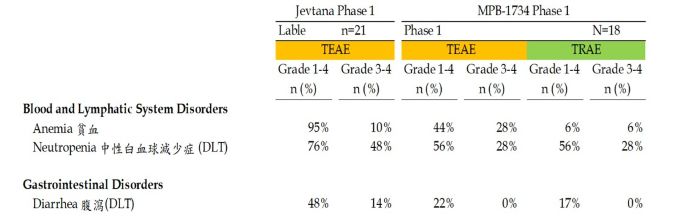
● Common treatment-emergent adverse events observed in the MPB-1734 Phase I trial included neutropenia, anemia, and diarrhea. The relevant data are presented in the table below and showed a trend toward lower incidence compared with historical cabazitaxel trial data.
U.S. Regulatory Development Strategy
- ● MegaPro Biomedical has received written feedback from a U.S. FDA Type C Meeting. Based on the available nonclinical and partial human data, the FDA feedback supports the Company’s evaluation of a bioequivalence (BE) study as a scientific bridge for seeking approval of a new drug application for the prostate cancer indication under the 505(b)(2) pathway. The Company will complete the necessary process, quality, and additional study work in accordance with regulatory feedback and further confirm the BE study design.
Next-Stage Development Direction
● Complete process optimization, scale-up, and CMC work required for registration.
● Confirm the bioequivalence study design with regulatory authorities and advance the trial application.
● Use prostate cancer as the primary development direction under the 505(b)(2) pathway.
● Continue evaluating development opportunities for MPB-1734 in head and neck cancer and other solid tumors.
Important Notice: MPB-1734 is an investigational product and has not received marketing authorization in any country or region. This content is provided solely to present the Company’s technology and R&D progress. It does not constitute product advertising, medical advice, or diagnostic or treatment recommendations. The product’s safety and efficacy remain subject to review and approval by the relevant regulatory authorities.