
Product Positioning
MPB-2043 is an ultrasmall superparamagnetic iron oxide (USPIO) nanoparticle MRI contrast agent independently developed by MegaPro Biomedical. It is being developed to support the assessment of lymph node metastasis in patients with solid tumors. The product leverages the uptake of nanoparticles by immune cells and the lymphatic system to create signal differences on MRI, helping assess whether lymph nodes may be affected by tumor metastasis.
Product Features
● Lymph Node-Specific Imaging Assessment
Following intravenous administration, MPB-2043 can be taken up by the reticuloendothelial system and immune cells, producing imaging changes in normal lymph nodes, while lymph nodes potentially affected by tumor metastasis may exhibit different signal patterns.
● Potential for Noninvasive MRI Assessment
The product uses standard MRI sequences (T1/T2/T2*) to evaluate lymph node imaging characteristics as a research tool supporting cancer staging and treatment decision-making.
● Extension of the Nanoparticle Technology Platform
MPB-2043 and MPB-1523 are both based on MegaPro Biomedical’s iron oxide nanoparticle technology platform. The products may share certain development experience and manufacturing platform capabilities to facilitate subsequent clinical and regulatory advancement.
● Clinical Need
Determining whether cancer has spread to the lymph nodes is important for cancer staging and treatment strategy development. Lymph node metastasis assessment is needed for many cancers, including breast, lung, prostate, head and neck, and gastric cancers. Clinically, lymph nodes often need to be surgically removed and examined pathologically to confirm metastasis. Accordingly, there remains a need to improve imaging interpretation efficiency and the precision of treatment planning.
Preclinical Research Features
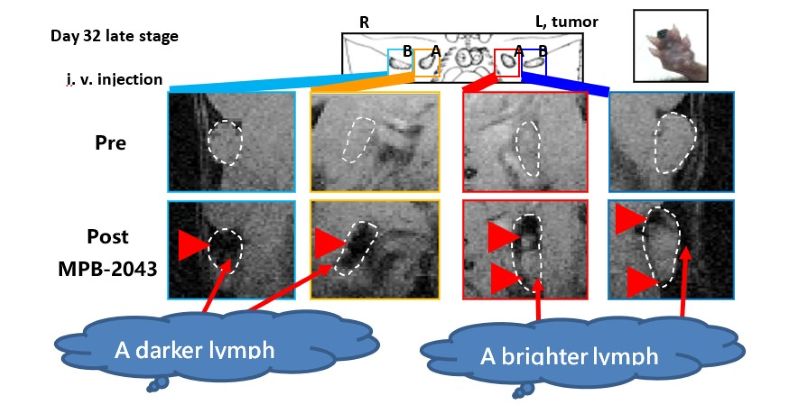
● Animal studies showed that MPB-2043 was distributed in lymph node tissue and produced signal differences on MRI. Imaging interpretations were consistent with pathological analyses, supporting the feasibility of further clinical development.
R&D and Regulatory Progress
● MPB-2043 is being developed through the 505(b)(1) new drug pathway, with imaging assessment of tumor lymph node metastasis as its primary indication.
● The current primary study population includes patients with head and neck cancer. Future evaluations may include applications in breast cancer, lung cancer, prostate cancer, and other solid tumors requiring lymph node metastasis assessment.
Next-Stage Development Direction
● Complete enrollment and data analysis for the investigator-initiated trial (IIT) in Taiwan.
● Establish clinical proof of concept.
● Advance planning for a Phase II clinical trial.
● Evaluate collaboration opportunities with international diagnostic imaging and medical device partners.
Important Notice: MPB-2043 is an investigational product and has not received marketing authorization in any country or region. This content is provided solely to present the Company’s technology and R&D progress. It does not constitute product advertising, medical advice, or diagnostic or treatment recommendations. The product’s safety and efficacy remain subject to review and approval by the relevant regulatory authorities.