
Technology Platform

Nano Graft Technology Platform

Nano grafting technology

Nano-graft reaction is to combine nano-particles and modifiers through chemical reaction to change the surface structure and state of nano-particles to achieve the purpose of surface denaturation. Nano-grafting technology occupies an extremely important position in the surface modification of nano-particles. Due to the fact that nano particles are larger than its surface area, the surface bond state and electronic state are different from the interior of the particles, and the incomplete coordination leads to the existence of a large number of bonding groups, which also provides favorable conditions for surface modification of nanoparticles. Surface chemical modification methods can be roughly divided into

1. Coupling agents: Inorganic nanoparticles are generally incompatible with organic materials commonly used for surface modification, so usually the help of coupling agent is required.  Coupling agents usually require two functional groups that can react with the surface of nanoparticles and can react with organic modifiers.  For instance, as of organo-silane (XR-Si (OR) 3), X is an organic functional group, one of the most representative types of coupling agents.

2. Esterification: The reaction between nanoparticles and alcohols is an esterification reaction. The esterification reaction can change the hydrophilic and hydrophobic properties of the surface of nanoparticles.

3.Polymerization graft modification: The use of chemical polymerization to graft polymers to the surface of nanoparticles to achieve the purpose of surface modification. The polymerization grafting method can be divided into.

    (1) The initiator initiates the direct polymerization of monomers into polymer chains on the surface of nanoparticles.

    (2) The use of chemical reactions to link polymer links to the surface of the particles.

The surface modification method can effectively improve or change the dispersion, weather resistance, durability and surface activity of nanoparticles, so that nanoparticles can produce new physical, chemical and optical properties to adapt to different application requirements.
Nanomedicine technology

Nanomedicine Technology

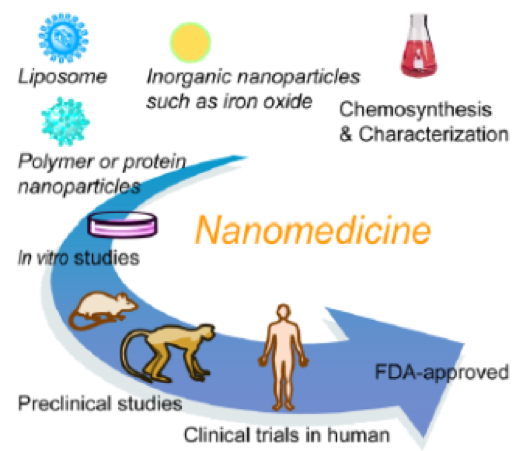
Nanotechnology is a practical application of technology that uses physical cutting, chemical synthesis, and other methods to achieve the control of the structure and shape of objects to attain nanometer size.  Nanotechnology is a cross-disciplinary technology, so the fields of its applications cover various industries, including chemistry, energy, machinery, electronics, biology, medical treatments, pharmaceuticals, beauty, etc.  In the field of medicine and health, nanobiotechnology possesses a wide range of applications and apparent industrialization prospects, especially in drug nanotechnology, nano drug carriers, nano biosensors, imaging technology, miniature smart medical devices.  It also plays a critical  role in disease diagnosis, medical treatments, and health care.

In terms of enhancing drug absorption, establishing new drug control systems, improving drug delivery, replacing viral carriers and designing adjuvant drugs, nanotechnology has provided novel solution for the development of new drugs and carriers, while being able to overcome challenges that could not be solved by traditional drugs or techniques.

The application of nanoparticles in pharmacy can be divided into nanomedicines and nanocarriers. After a drug is minimized to nano size, its bioavailability, uniformity, dispersion and absorption can all be increased. The application of nano drug delivery can make insoluble drugs soluble in water, provide different routes of drug administration, or change the kinetic characteristics of drug absorption, distribution, metabolism, excretion, and even achieving the functions of  slow release transmission and targeting effect.  The development of nano medicines in recent decades has played an important role in medical and health care. At present, more than 200 nano drug products have passed the validation from the Regulatory Agency or are in the processes of clinical trials.

When drugs are combined with an appropriate nanocarrier, the release of the drug can be controlled at a specific target organs or moleculars according to the needs of treatment. Nanocarriers provide a new method for the study of controlled release of drugs with its small size and large surface area effects. The ideal nanocarrier should have the following properties: higher drug loading, higher drug encapsulation efficiency, simple preparation and purification methods, and easy to scale up to industrial production. The carrier materials should be biodegradable, low toxicity, with proper particle size and shape, while having a longer circulation time in the body.  In recent years, there are many different nanocarriers systems has been developed based on different drug properties and preparation methods, including nanoparticles, nano-structured liposomes, solid lipid nanoparticles (SLP), nanosuspensions, magnetic nanoparticles, etc.


Table

Nano Encapsulation Technology Platform

Nano Encapsulation Technology

Nano encapsulation technology mainly improves the clinical unmet needs and limitations of clinical use of drugs through the unique properties of nano carriers and drug encapsulation technology, such as poor water solubility, low bioavailability, insufficient drug retention time in the blood, or insufficient drug concentration as distributed to the sites of infection, causing low drug efficacy and unexpected side effects.  When the drug is successfully and stably encapsulted in the nanocarrier, the following advantages can be achieved:

  1. The original characteristics of absorption, distribution, metabolism, and elimination of the drug can be altered.
  2. While non-soluble drug is encapsulated with nano-micelle, the solubility can be greatly improved and its clinical application value is greatly increased.
  3. Rapid inactivation of drugs after entering the body can be avoided, especially for protein drugs and DNA delivery.
  4. The absorption and body utilization can be increased. The enhancement of skin penetration of drugs can be achieved by changing the administration route.
  5. Drugs can be provided with the function of tumor tissue passive targeting, to achieve the function of increasing efficacy and reducing side effects.

The research and development team of MegaPro Biomedical has accumulated more than ten years of experience in nano encapsulation technology, and related products are set to enter the pipeline in the future.